A payment can be correctly signed and still be one that should never have been approved. In an article published on November 13, 2026, Ken Wong, founder of BitDATA PayFi Infra and a former cybersecurity researcher, argues that crypto security must address not only code and key protection, but also what authorized people and services can do. The article was translated by AididiaoJP for Foresight News.
Where the losses occurred
Wong cites Hacken’s third-quarter 2026 security and compliance report: 107 incidents caused $1.18 billion in losses, up 55% from the previous quarter. Smart-contract vulnerabilities accounted for 48% of losses; access-control and operational failures accounted for 40%.
Those categories call for different defenses. An audit may help find a contract flaw, but it does not by itself answer whether an internal service has too much authority to move funds—or what happens if that service is compromised.
From a request to a transfer
The distinction matters at each step of a payment. Authentication establishes who is making a request. Authorization establishes what that identity is permitted to do. A further check asks whether this particular transfer, in its current context, should proceed. A valid credential or signature answers neither of those last questions automatically.
As an example, Wong points to Binance’s October 29, 2026 security incident statement. According to the account cited in his article, approximately $6.34 billion in digital assets was affected, about $2.85 billion was frozen or intercepted, and 98% of affected token assets had been recovered by October 31. The reported attack path was unauthorized access to an internal wallet transaction-signing service, bypassing the usual withdrawal process. Wong’s architectural point is that securing private keys is not the same as constraining a service that already has transaction authority.
That problem can span a PayFi payment journey. Wong describes transactions passing through a wallet or custodian, an API gateway, orchestration and risk-control systems, signing or settlement components, and banking or payment partners. Each handoff has its own permissions and dependencies. If an automated service is allowed to initiate a request, that should not automatically give it authority to approve a new recipient, raise a limit or release funds without an independent check.
Security also means staying available
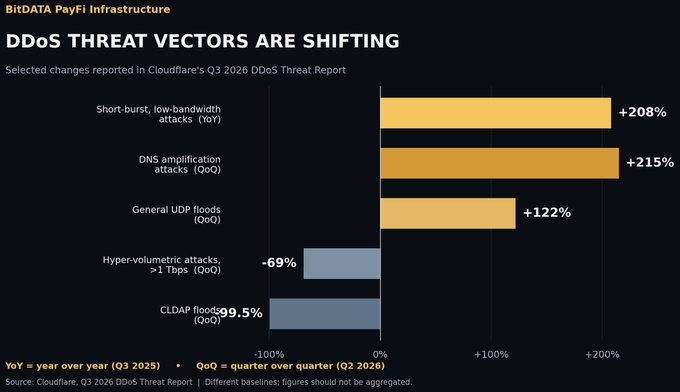
Wong also cites Cloudflare’s third-quarter 2026 DDoS threat report. Cloudflare said it mitigated 18.2 million network-layer DDoS attacks and 14.4 trillion HTTP DDoS requests that quarter, averaging roughly 8,226 network-layer attacks per hour. It reported increases of 208% in short, low-bandwidth attacks, 215% in DNS amplification attacks and 122% in UDP floods. For payment services, Wong’s takeaway is that availability and recovery belong alongside theft prevention in a security plan.
His proposed priorities are narrower permissions, transaction-level checks for higher-risk actions, measurable operational resilience, and records showing who initiated, authorized and executed a movement of funds. Smart-contract audits and key management remain necessary; they simply do not settle the question of whether a trusted identity was entitled to make a particular payment.
Source: panewslab.com (originally published 2026-11-13 13:44 UTC+8)