
Originally reported on November 14, 2026, at 15:23 UTC+8.
On November 10, 2026, blockchain project Alta announced a $47.5 million Series A round. Together with a $32.5 million seed round, that brought its reported funding to $80 million. Index Ventures led the Series A, with GV among the participating investors. Airwallex CEO Jack Zhang was named as an Alta co-founder.
The move follows Zhang’s public criticism of stablecoins in June 2025. He questioned whether they actually reduce cross-border payment costs, arguing that converting them back to fiat could cost more than using the traditional interbank foreign-exchange market. The distinction in the original report is that Alta is pursuing institutional settlement infrastructure, not simply a cheaper way for individuals to exchange currencies.
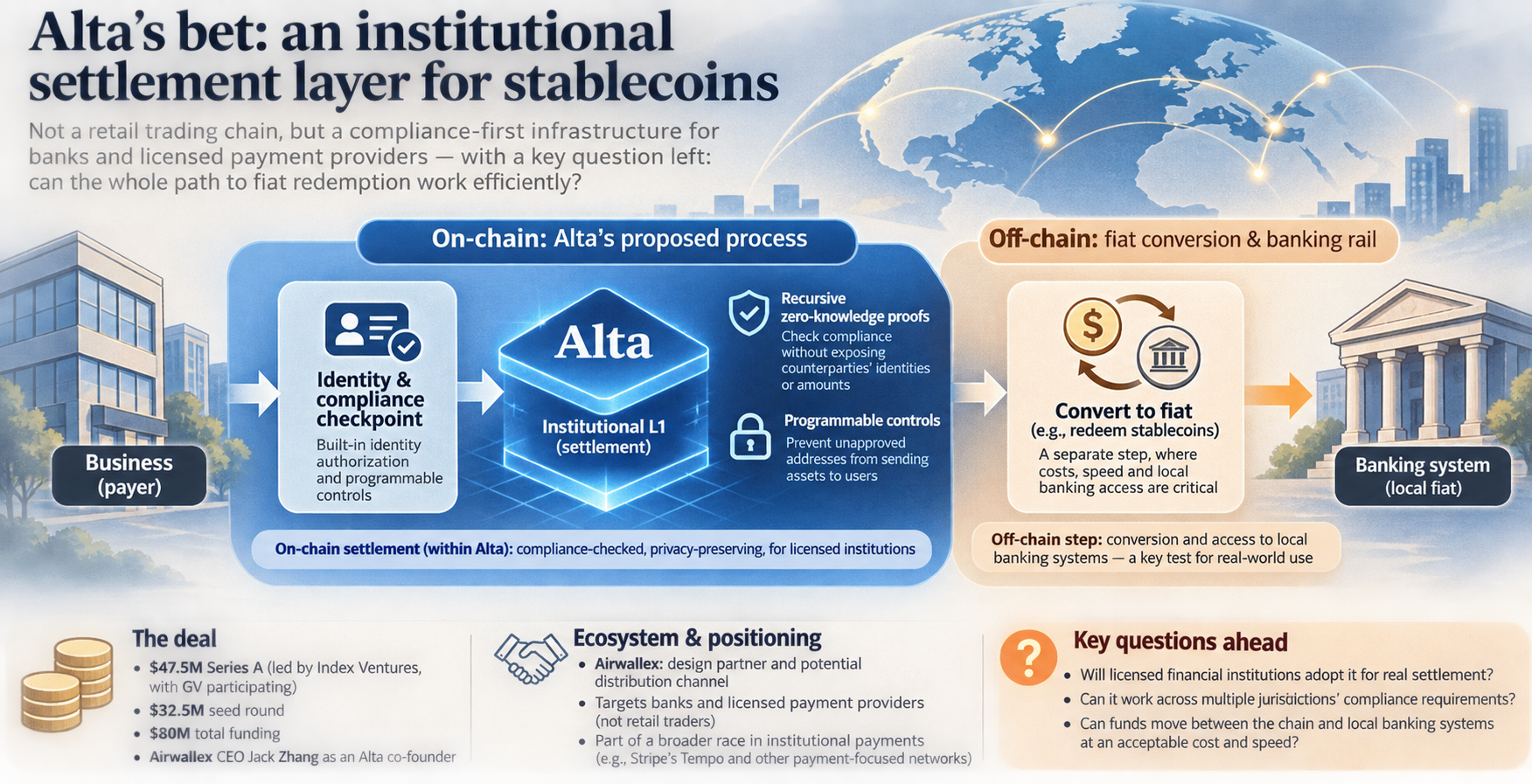
What Alta proposes
Alta describes its planned layer-1 network as serving banks and licensed payment providers rather than retail traders. According to the report, its design uses recursive zero-knowledge proofs to check transactions against compliance requirements without exposing counterparties’ identities or transaction amounts on-chain. It also proposes built-in identity authorization and controls that would prevent unapproved addresses from sending assets to users.
For a business making a payment, those features would address only the on-chain part of the journey. The report identifies a separate test: whether funds can move efficiently between the network and local banking systems. If converting stablecoins back to fiat remains costly or slow, faster on-chain settlement would not resolve the problem Zhang raised in 2025.
Airwallex is described as a design partner and potential distribution channel for Alta. That gives Alta a connection to an existing payments network, but it does not establish that Airwallex customers have moved their core settlement activity onto the chain. Adoption by other financial institutions, compliance across jurisdictions and access to fiat liquidity remain open questions.
The report places Alta alongside payment-focused networks being developed by competitors, including Stripe’s Tempo. Its central question is not which project can announce a chain, but whether licensed institutions will use one for real settlement—and whether the complete route from payment to fiat redemption works at an acceptable cost.
Source: chaincatcher.com (originally published 2026-11-14 15:23 UTC+8)