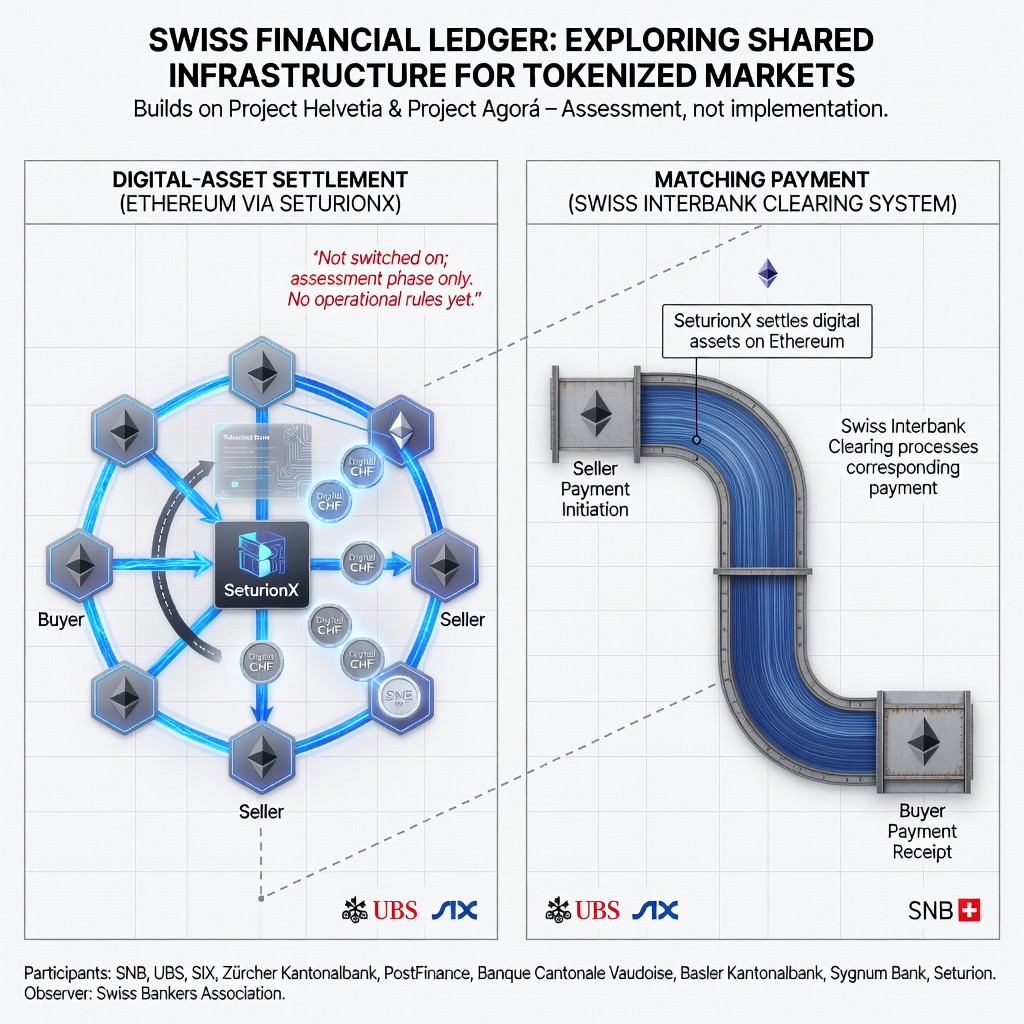
On November 24, 2026, the Swiss National Bank announced a joint initiative with eight financial institutions, including UBS and SIX. The Swiss Financial Ledger project will examine settlement options for domestic and international transactions in tokenized markets. It is an assessment of shared infrastructure, not a ledger that has been switched on and not a new rule institutions must already follow.
Who will take part
With the central bank, the group has nine institutions. Besides UBS and SIX, the participants are Zürcher Kantonalbank, PostFinance, Banque Cantonale Vaudoise, Basler Kantonalbank, Sygnum Bank, and Seturion. Together they will evaluate the technical requirements of a shared financial platform, and they will also assess operational risks, governance, and potential economic benefits.
The work is meant to examine how central bank money, commercial bank deposits, and securities could interact through distributed ledger technology. The participants have set up a Helvetia Strategic Board to coordinate discussions. The Swiss Bankers Association will take part as an observer.
The project also builds on Project Agorá, an international initiative of central banks and private financial institutions. Agorá looks at whether tokenization can make cross-border payments faster, cheaper, and safer. Its prototype has already supported real-value transactions involving multiple currencies and participating institutions.
Two ways a tokenized trade can settle today
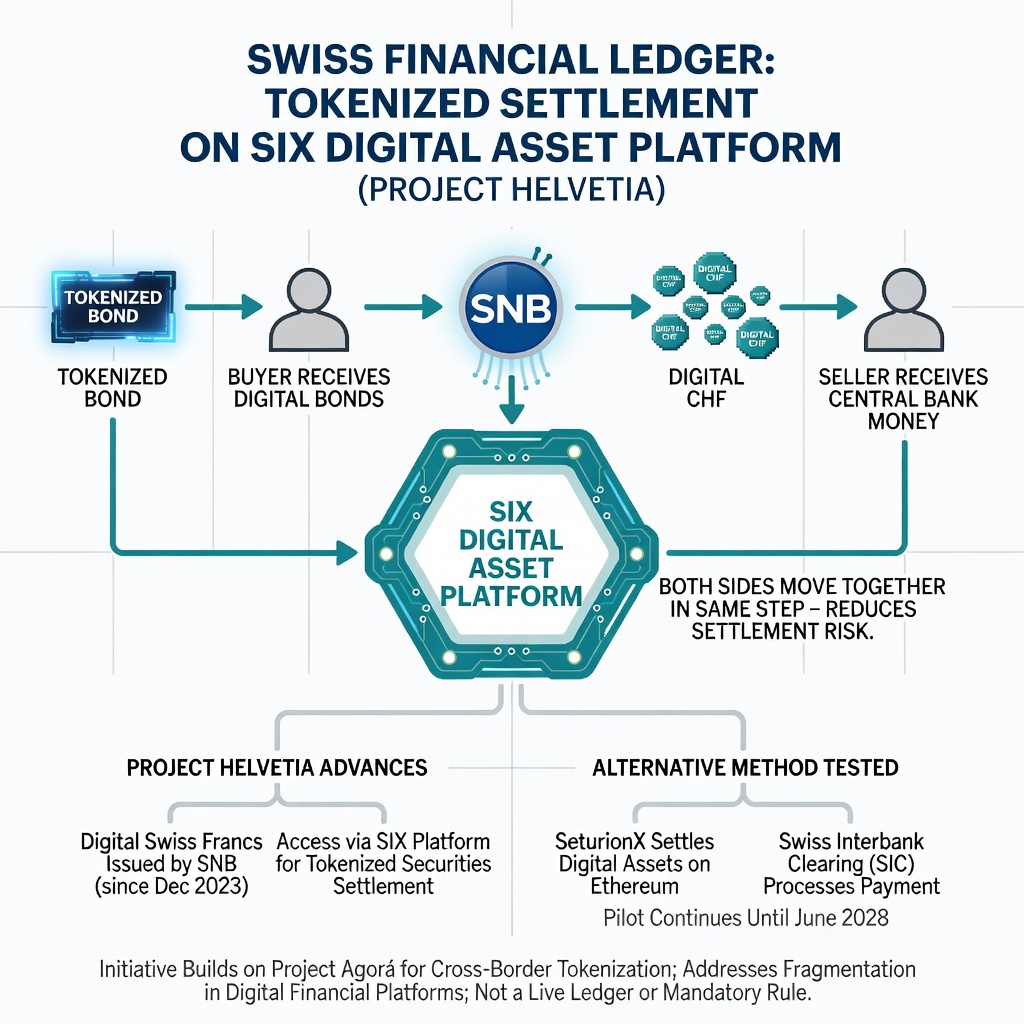
The new study builds on digital settlement experiments already running under Project Helvetia. In December 2023 the Swiss National Bank began issuing wholesale central bank digital currency for that project. Financial institutions access those digital Swiss francs through the regulated SIX Digital Asset Platform, and banks use the funds to settle transactions in tokenized securities. Participating banks can already settle tokenized bond transactions with digital Swiss francs from the central bank.
On that platform, both sides of the trade can move together. The buyer receives the digital bonds while the seller receives central bank money inside the same infrastructure. Coordinating delivery and payment is intended to reduce the risk that one side settles and the other does not.
Project Helvetia is also testing a second method that keeps the payment on Switzerland’s existing interbank infrastructure. In that arrangement, SeturionX settles the digital assets on Ethereum, while the Swiss Interbank Clearing system processes the corresponding payment. The central bank will continue the pilot until at least June 2028.
What the shared ledger is being asked to address
The initiative is aimed at the difficulty of connecting separate digital financial platforms. A shared infrastructure could reduce settlement fragmentation and improve coordination among institutions. Central bank money is part of that discussion because it can serve as a settlement asset without the credit risk of a private issuer.
Other digital-money projects in Switzerland are moving on separate tracks. Earlier in 2026, six major Swiss banks introduced a Swiss franc stablecoin sandbox. Separately, UBS recently used Chainlink technology to automate processes involving tokenized structured notes on Ethereum. Neither is described as part of the Swiss Financial Ledger, which remains a joint study of how shared settlement infrastructure might work.