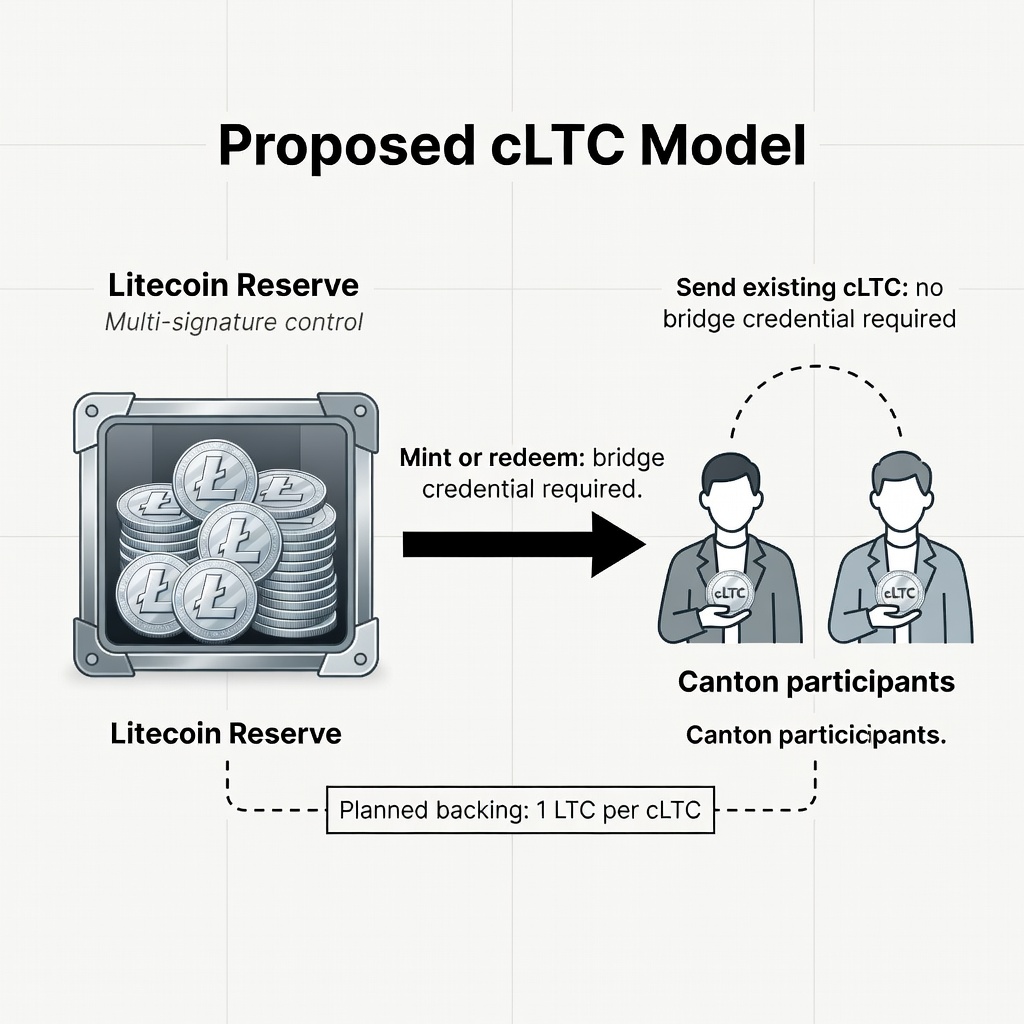
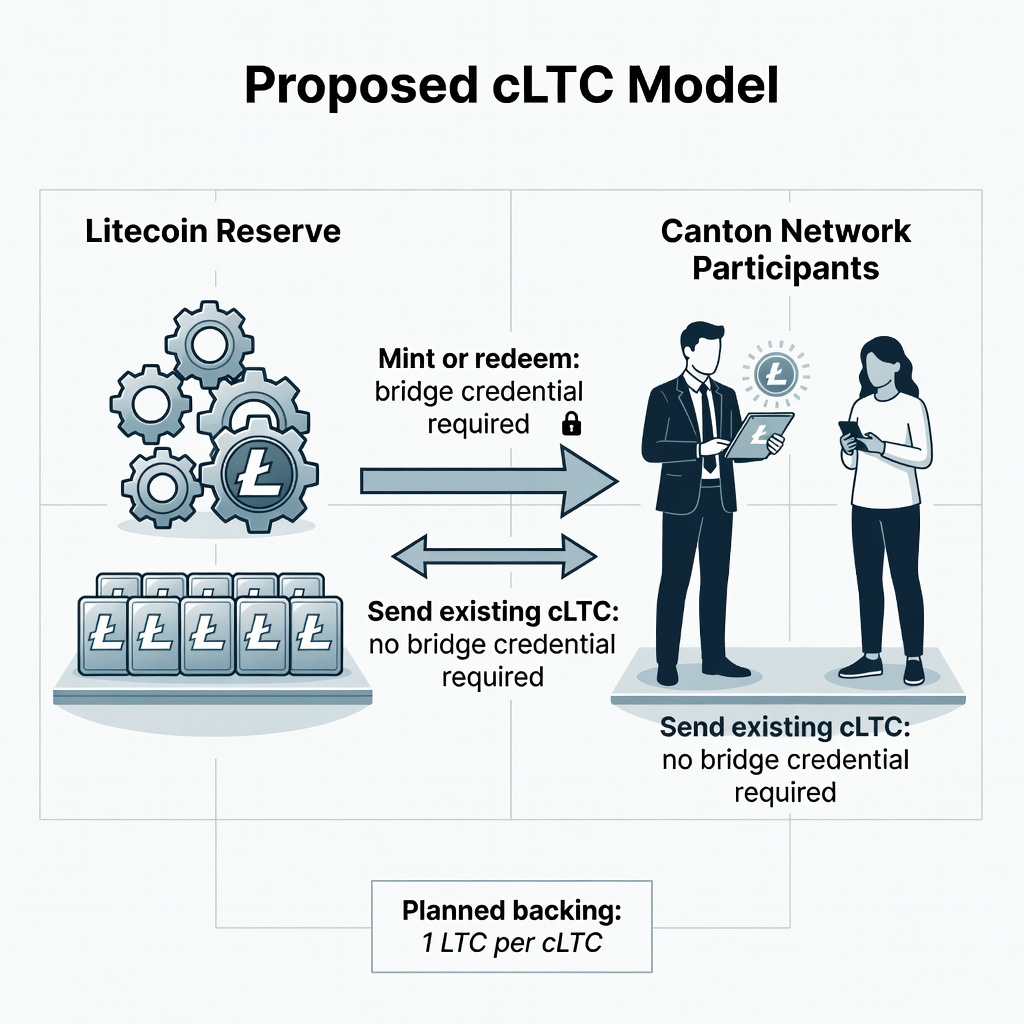
Greywick Digital is developing cLTC, a Canton Network token designed to be backed by one Litecoin (LTC) per token. Canton announced the plan on November 23, 2026, with a late-2026 mainnet target. Under Greywick’s published terms, Canton participants would be able to send existing cLTC to one another without a bridge credential. They would need that credential to mint cLTC or redeem it for LTC. The product was not live as of November 25.
On the same day as Canton’s announcement, Litecoin reported a separate development: daily transaction counts on its optional privacy layer had held at roughly four times their previous average for ten days. That figure measures transfers of LTC, not demand for the proposed Canton token.
How participants could check the cLTC reserve
Greywick says the Litecoin reserve would be under multi-signature control. It plans to publish the reserve addresses and explain how they are derived, so that someone running a Litecoin node could independently calculate how much LTC those addresses hold. The reserve would initially be capped, with increases after periods of smooth operation, according to Greywick.
The Litecoin Foundation has endorsed the project. In a statement published by Greywick, David Schwartz, the Foundation’s director of strategic partnerships, said cLTC could give institutions a route to Litecoin when they otherwise have no reason to use existing ones.
More MWEB transfers, less LTC in the pool
Unlike cLTC, Litecoin’s Mimblewimble Extension Blocks (MWEB) do not introduce a separate token. Since the feature went live in May 2022, users have been able to move LTC from the main chain into a parallel extension chain, where transfer amounts are hidden, and move it back later.
Litecoin’s November 23 figures, reported by AMBCrypto, showed more than 2,000 MWEB transactions on several November days, compared with a few hundred on many earlier days. Yet SoChain data cited by crypto.news showed the pool held 519,341 LTC on November 23, down 38,685 LTC from 558,026 LTC on November 10. Transfers within MWEB do not change the pool’s balance, and one wallet or service can make repeated transfers. The higher count therefore establishes neither a larger pool nor more distinct users.
For someone sending LTC to an exchange, the transfer route matters. Binance said in a June 2022 notice that it would reject MWEB deposits and withdrawals. Because it could not verify the sender’s address, it said it could neither credit nor return deposits sent that way. Bitkub cited securities regulator rules in a February notice excluding MWEB transfers. According to crypto.news, several South Korean exchanges moved to delist LTC in June 2022 after the upgrade. The outlet also reported that Litecoin reversed 13 blocks after an MWEB-related incident in April 2026; the Foundation said it had patched the issue.
Litecoin’s price in context
CoinGlass figures reported by crypto.news put LTC near $42 on November 23, up from a November 21 low of $37.73 but still about 25% below its October 31 close of $55.70. AMBCrypto offered a separate chart interpretation: it described the four-hour trend as bearish and said a close above $44.79 would change that reading. Over the longer term, it viewed September’s rally to $75.63 as a shift in trend and the dip below $39.28 as a possible liquidity sweep, noting that no week had closed below that level. Neither outlet attributed its price analysis to Greywick or Canton.
At 09:04 UTC on November 25, CoinPaprika put LTC at $40.40 (₹3,728), down 2.3% over 24 hours and 9.5% over seven days. Its market capitalization was $3.05 billion, with $217.5 million in 24-hour trading volume. Canton’s CC token stood at $0.0753 (₹6.95), down 1.9% on the day and 10.4% on the week.