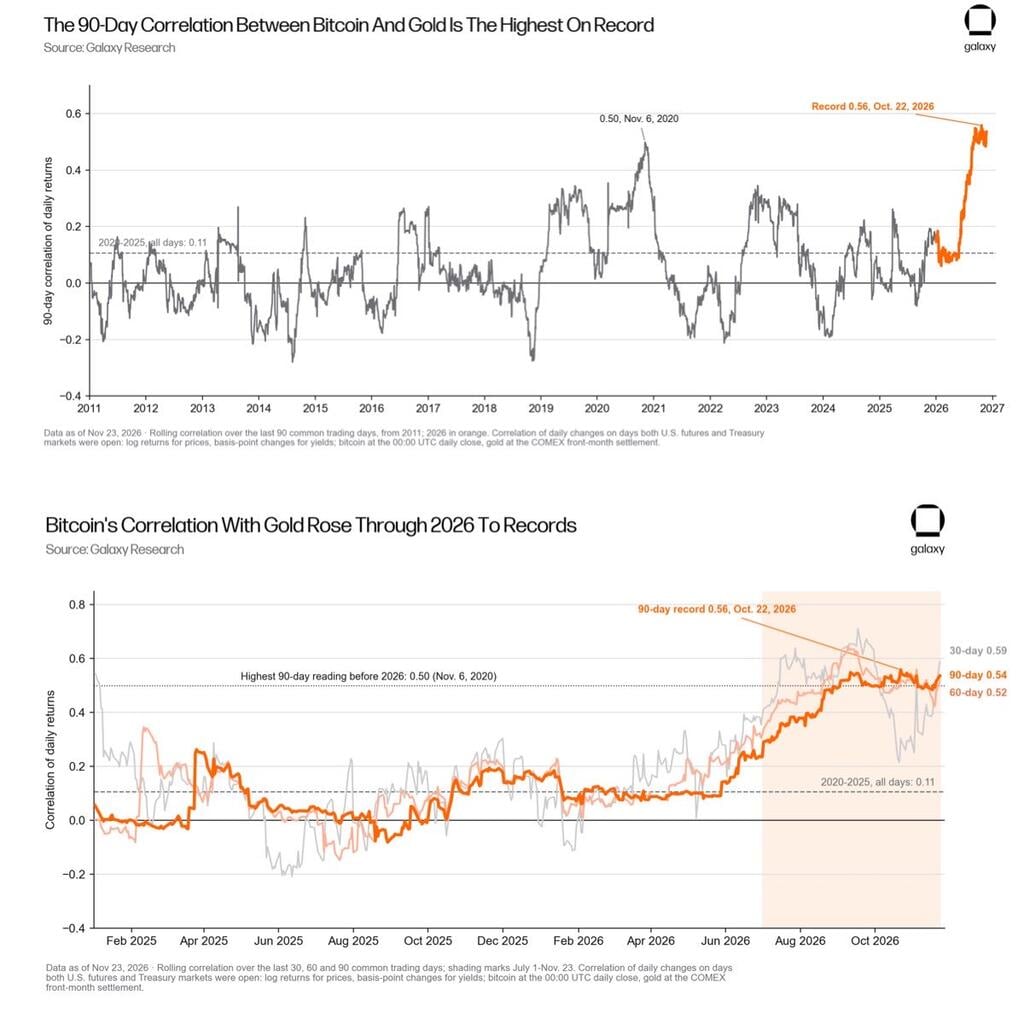
Bitcoin’s price movements tracked gold more closely in the 90 days through Oct. 22, 2026, than in any other 90-day window in Galaxy Research’s data. The correlation reached 0.56, above the previous record of 0.50 set on Nov. 6, 2020, according to charts Alex Thorn, head of firmwide research at Galaxy Digital, shared on X on Nov. 27.
The change came largely in the second half of 2026. The 90-day reading hovered near 0.1 in the first half, close to its 2020–2025 average of 0.11. It began rising in July and passed 0.50 by early October. By Nov. 23, it had eased to 0.54, still above the 2020 record. The correlation over the shorter 30-day window was 0.59 on the same date.
What the record says about ‘digital gold’
A positive correlation means the two assets tended to move in the same direction over the period. It does not mean they delivered the same return. Thorn invoked the comparison in his Nov. 27 post, asking, “Bitcoin isn’t digital gold?”
Earlier in the year, Galaxy executives had emphasized the differences. On Jan. 20, CEO Mike Novogratz wrote on X that “the gold price is telling us we are losing reserve currency status at an accelerating rate.” He contrasted that with Bitcoin, which he said was still facing selling pressure.
In February, Thorn wrote that Bitcoin’s failure to trade like gold in the “debasement trade” since September 2025 had hurt its appeal to newcomers. He said the “digital gold” label described Bitcoin’s fundamental properties, not an expectation that it would amplify gold’s price moves.
Galaxy withdraws its call that Bitcoin bottomed in June
In a separate Nov. 25 report, Galaxy withdrew its Oct. 26 assessment that Bitcoin’s bear market had ended in June. Bitcoin closed the week ended Nov. 22 at $61,104 after seven consecutive weekly losses.
Galaxy’s historical comparisons pointed in different directions. By Nov. 22, the bear market had lasted 412 days, longer than the 163 to 406 days from peak to trough in earlier downturns. Yet Bitcoin was down 53% from its October 2025 record, compared with declines of 77% to 93% in past bear markets. Only two of the 13 signals Galaxy tracks for a market bottom had been met. The report also put U.S. spot Bitcoin exchange-traded product holdings at about 1.24 million BTC, down 71,339 BTC since Oct. 4.
Thorn identified $58,525, Bitcoin’s June 30 closing low, as the threshold for his outlook. In his assessment, a daily close below it would mark the start of a move to a substantially lower low. Galaxy identified roughly $48,500 and $28,200 as possible lows if the June level breaks, not as prices Bitcoin had reached.
Novogratz had expressed doubt about a year-end rebound on Nov. 17. At the Digital Assets Forum in New York, SkyBridge Capital founder Anthony Scaramucci asked whether Bitcoin could return to $90,000 by the end of 2026. “Unlikely now,” Novogratz replied. “Less likely than it was. You need something to happen.”