A wallet tied to the October 2026 Binance breach sent 11,989 ETH, worth about $20 million, to an address with no known owner, according to Whale Alert. At the time of the November 27, 2026, report at 10:06 a.m. EST, roughly $1.9 billion in stolen assets remained unfrozen. The transfer did not establish that the ETH had been sold.
Investigators identified approximately 12,000 wallets involved in laundering the stolen funds. Researchers found that the attackers repeatedly moved batches of close to 12,000 ETH to make the funds harder to trace, though the recurring amounts also gave analysts a pattern to flag.
Some earlier movements were considerably larger. The attackers moved 78,400 ETH, then worth about $142 million, on November 18 and another 137,602 ETH, worth roughly $248 million, on November 19. On November 26, on-chain analysts flagged attacker-linked ETH transfers totaling $35.52 million.
Why some funds could be frozen
On October 29, attackers drained approximately $6.3 billion from Binance hot wallets across ten blockchains. Ethereum and Bitcoin accounted for most of the losses. The FBI and blockchain analysis firms attributed the breach to TraderTraitor, a group linked to North Korea. Binance pledged to cover the losses from its own reserves and had begun gradually reopening withdrawals to users.
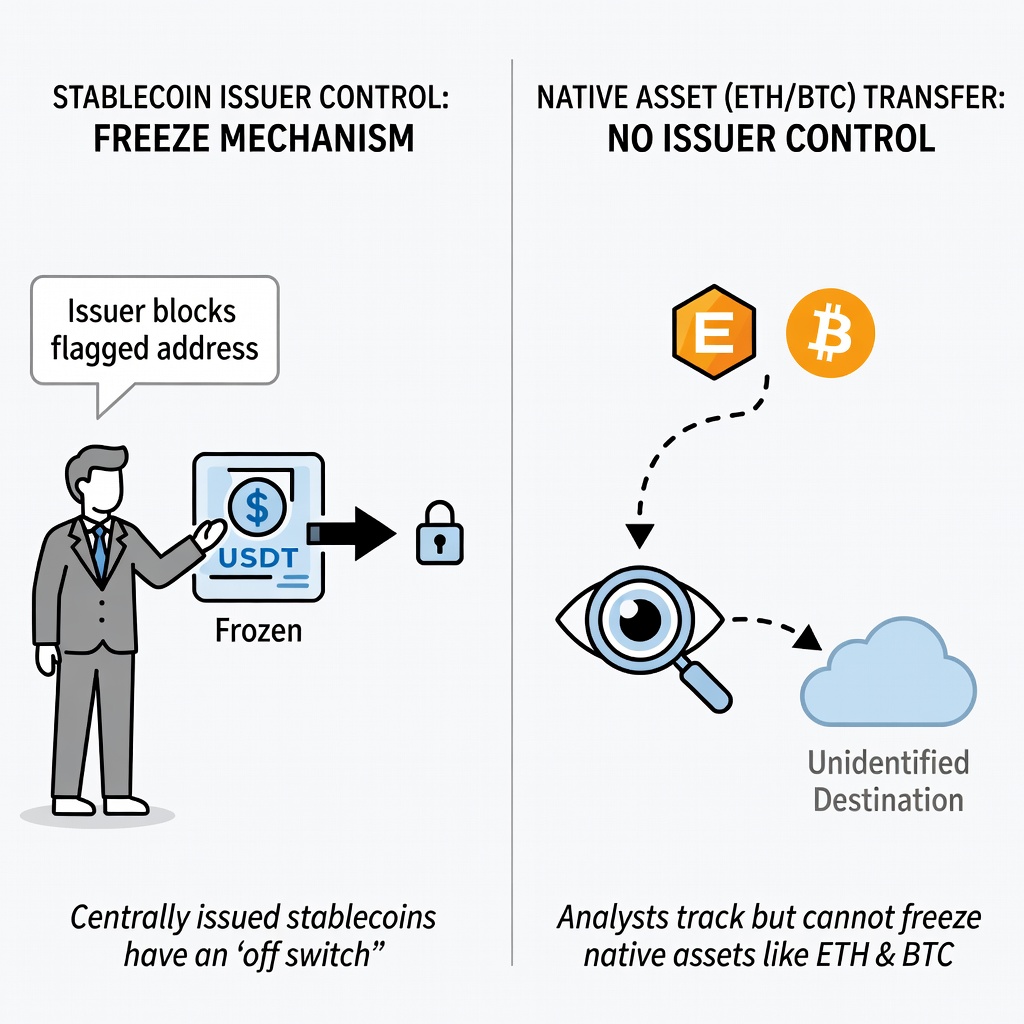
Stablecoin issuers, including Tether and Circle, froze an estimated $2.6 billion to $2.85 billion in stolen tokens. An issuer can block an address from transferring its stablecoin. ETH and BTC have no equivalent issuer control: analysts can track transfers, but identifying an address does not stop its owner from sending funds elsewhere.
The unfrozen holdings included about 461,980 ETH, valued at roughly $785 million, and 18,350 BTC, valued at about $1.11 billion. A transfer to an exchange or swap service could indicate an attempt to cash out, but the destination of the 11,989 ETH transfer remained unidentified.