Before Anthropic listed on Nasdaq on November 19, 2026, its pre-IPO contract on OKX briefly traded at about 103 USDC, roughly 24% above the $83 IPO price, according to a November 28 analysis by imToken. After the listing, several crypto platforms introduced tokenized products tied to the stock. Buyers could use stablecoins rather than fund a brokerage account, and some products traded around the clock.
Trading access is not the same as share ownership. A token can carry the rights of a share, give its holder a claim against a separate issuer, or simply track a stock’s price. That distinction matters when a company pays a dividend, calls a shareholder vote or takes another action that affects investors.
Three ways to bring stocks onchain
The New York Stock Exchange is building around shareholder rights. In January 2026, its parent, Intercontinental Exchange (ICE), announced plans to connect the NYSE’s Pillar order-matching engine to blockchain systems for post-trade processing, settlement and custody. The platform would support fractional trades, 24-hour trading in US-listed stocks and ETFs, and immediate settlement, with stablecoins available for payment.
The design covers both tokenized shares interchangeable with conventional shares and securities issued digitally from the outset. Unlike a token that merely tracks a price, a tokenized share under this model would retain the underlying stock’s dividend and governance rights. On November 2, the NYSE named Securitize, tZERO, Superstate, Broadridge, Computershare and Equiniti as transfer-agent partners, connecting the project to the firms that maintain shareholder records.
OKX is pursuing two distinct routes. In June, OKX and ICE formed OKXICE, a joint venture that submitted a trading-venue plan to the US Securities and Exchange Commission (SEC) in October. According to imToken, OKXICE launched its tokenized securities venue on November 23.
Separately, OKX introduced Unified Tokenized Stocks in November for its crypto users. The product brings tokens from different issuers under the xStocks framework into one order book for each underlying stock, with common rules for handling corporate actions. Users can trade around the clock with USDT and withdraw tokens to Solana or X Layer. What they can transfer, however, is price exposure: the tokens do not confer equity in the underlying company or voting rights.
Robinhood’s tokens are backed by shares but are not themselves shares. Its Jersey subsidiary introduced a new generation of Stock Tokens in July. The issuer buys and holds the corresponding securities as collateral; the customer holds a tokenized debt security, without legal ownership of the stock or shareholder rights. Alongside Robinhood Wallet and its onchain infrastructure, the product gives Robinhood a route from its existing brokerage customer base into tokenized finance.
These models do not necessarily share liquidity. Tokens tied to the same company can trade on different networks and venues, with different issuers, custodians and redemption terms. A common stock name does not make the tokens interchangeable.
A larger market does not necessarily mean fresh capital
CoinGecko’s November 2026 report put the market value of tokenized stocks at $2.71 billion as of October 21, up from $1.25 billion in July. Average daily trading volume reached about $402 million, excluding related perpetual contracts.
Those figures measure market size and activity, not where the money came from. Tokenized stocks, Treasuries and money market funds could attract brokerage customers to crypto platforms or give idle stablecoins a use. They could also draw funds away from DeFi lending, liquidity mining and trading in crypto assets.
Binance Research found that many tokenized real-world assets were still primarily held or traded, with more limited use in lending, as collateral or in portfolio strategies. For imToken, an important test is whether tokenization can both attract outside capital and give holders more ways to use their assets after purchase.
What regulators permit depends on the asset and the venue
In the United States, the SEC issued a temporary, conditional Innovation Exemption on September 17, 2026, according to imToken. It allows qualifying tokenized securities venues to trade certain US-listed stocks through permissioned automated market makers and liquidity pools without conventional exchange registration. The exemption limits eligible stocks and trading size. Holders must have the same rights as owners of conventional shares of the same class, and smart contracts must be publicly auditable. When a third party tokenizes a stock, the underlying issuer must receive notice and an opportunity to object.
In mainland China, a February 6 notice from eight authorities, including the central bank, the National Development and Reform Commission and the China Securities Regulatory Commission (CSRC), explicitly defined real-world asset tokenization. The notice, numbered 42 for 2026, said domestic tokenization and related intermediary and technical services were suspected illegal financial activities and should be prohibited. It reserved an exception for activities authorized by the competent authorities and conducted through designated financial infrastructure.
Separate CSRC guidance issued the same day addressed offshore asset-backed tokens whose repayment depends on cash flows from mainland assets. The mainland entity that controls those assets must file complete materials with the CSRC and comply with cross-border investment, foreign-exchange and network data security rules. Issuance cannot proceed without the applicable approval, filing or security review.
Hong Kong operates under a separate framework. On October 26, its Securities and Futures Commission approved the first two tokenized money market funds for round-the-clock secondary trading on licensed virtual asset platforms. On November 2, the Hong Kong Monetary Authority announced a new phase of Project Ensemble supporting 24/7 interbank settlement of tokenized deposits using tokenized central bank money. Participation rose to 12 banks and 20 industry institutions. At a joint event in November, the two regulators described the shift from experiments to commercial use: the next test was whether investment products and digital money would move through that infrastructure in actual transactions.
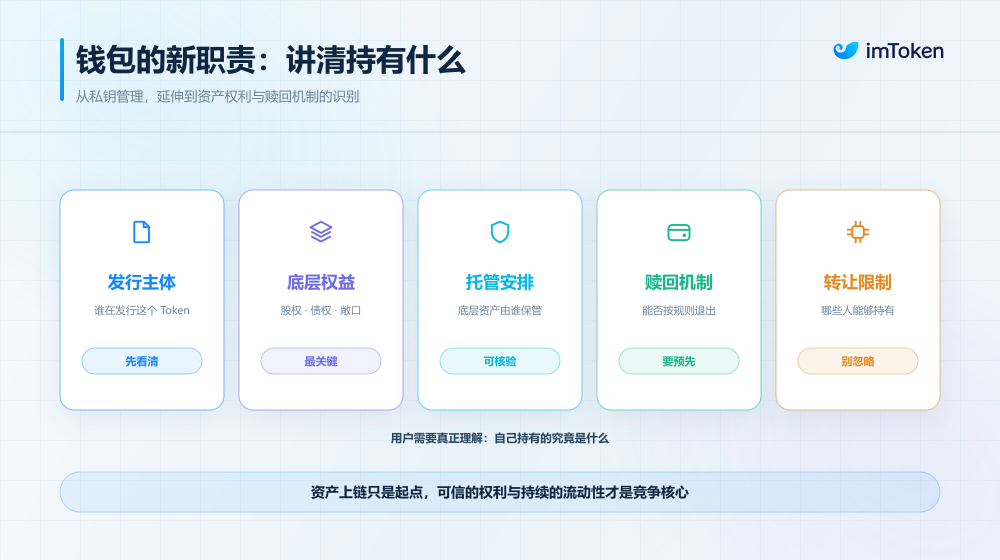
For wallet users, the practical question comes before settlement: what changes hands when the payment goes through? A balance and a stock name cannot answer it. As wallets begin to display more tokenized securities, imToken argues that they may need to identify the issuer, explain the holder’s rights, name who holds the underlying asset and show whether the token can be redeemed or transferred. Those details tell a buyer whether a completed trade delivered a share or a different claim tied to its price.