
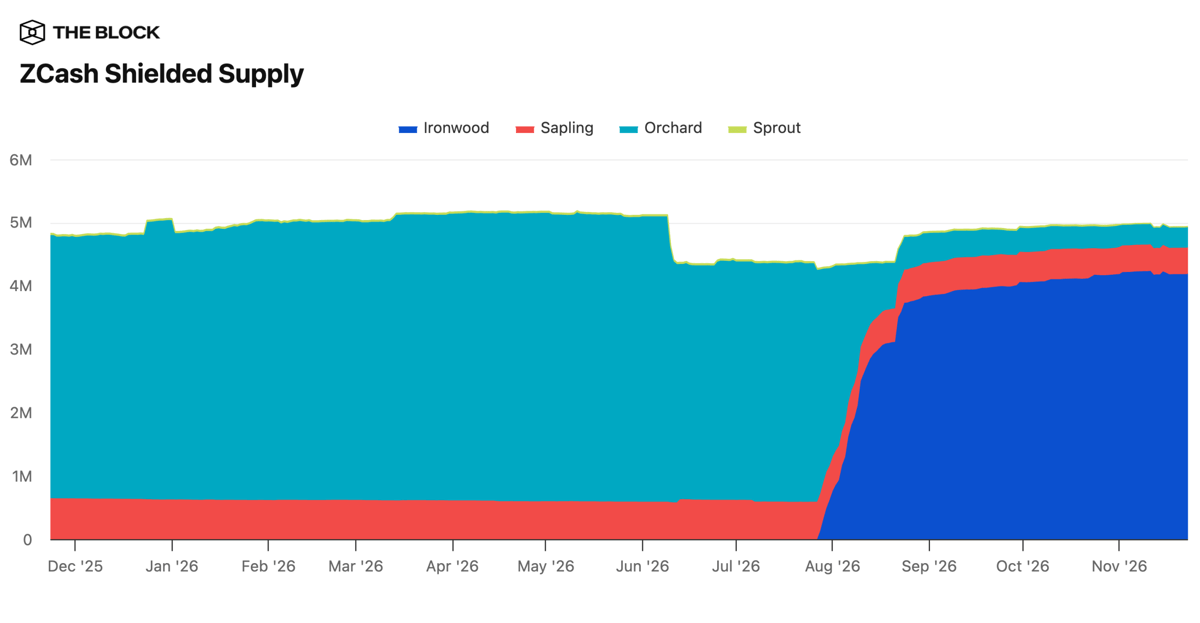
Zcash infrastructure team Zakura recommended on Nov. 26, 2026, that users move any ZEC they still hold in the Sapling shielded pool to Ironwood. It also called for a network upgrade to stop new payments into Sapling. The team set no deadline: the deposit cutoff was a proposal, not an active restriction, and Zakura said a practical break in Sapling’s cryptography remained highly speculative.
Both pools let users hold and send ZEC without publicly revealing amounts or the addresses of senders and recipients. Zakura said most wallets support both pools and expected limited disruption from closing Sapling to deposits. According to the team, Sapling still held roughly 400,000 ZEC, about 2% of supply, worth around $291 million at the time.
Miners accounted for much of the remaining activity. Zakura said fewer than 2.6% of all Zcash transactions in the preceding 30 days used Sapling. Of those, 66% were known miner flows, and the team considered it highly likely that miners accounted for most of the rest.
An April 2026 Zcash forum proposal had suggested waiting a year after a community decision before making Sapling withdrawal-only. That proposal put the pool’s balance at 600,000 ZEC, down from 1.1 million at the start of 2024. Zakura called for a faster phaseout without specifying a replacement timetable.
Why a deposit cutoff differs from a freeze
Closing Sapling to incoming payments would still let users move their existing funds out. Zakura discussed a separate contingency: freezing the pool if its pairing-based proof system were at risk. A practical break could allow someone to forge proofs, putting the pool’s funds at risk. But that proof system does not secure users’ private keys or their cryptographic records of shielded funds.
That distinction matters for recovery. If Zcash froze Sapling before an attack compromised the pool’s state, Zakura said, developers could replace the proof system while preserving those records. Users could then recover their funds using a new proof system, either an ECDLP-based or a hash-based SNARK.
Zakura cited a reported proof of the Riemann hypothesis, which concerns the distribution of prime numbers, and unsubstantiated rumors of advances at AI labs in factoring large integers. The difficulty of factoring underpins RSA encryption, which the team said cryptocurrencies rarely use. Some mathematics is relevant to attacks on both RSA and pairing-based systems, but neither the reported proof nor the rumors demonstrated a practical break in either system, Zakura said. Ironwood and transparent Zcash transactions rely on neither factoring nor pairings.
Separately, Zakura said it was developing a proposal for transparent Zcash transactions to support SPHINCS+, a hash-based, post-quantum signature scheme, with 192-bit security. The Ethereum Foundation had also doubled its protocol security team, describing AI as a more urgent risk than quantum computing and recommending Keccak-256 over four alternatives for Ethereum’s planned shift to hash-based cryptography.