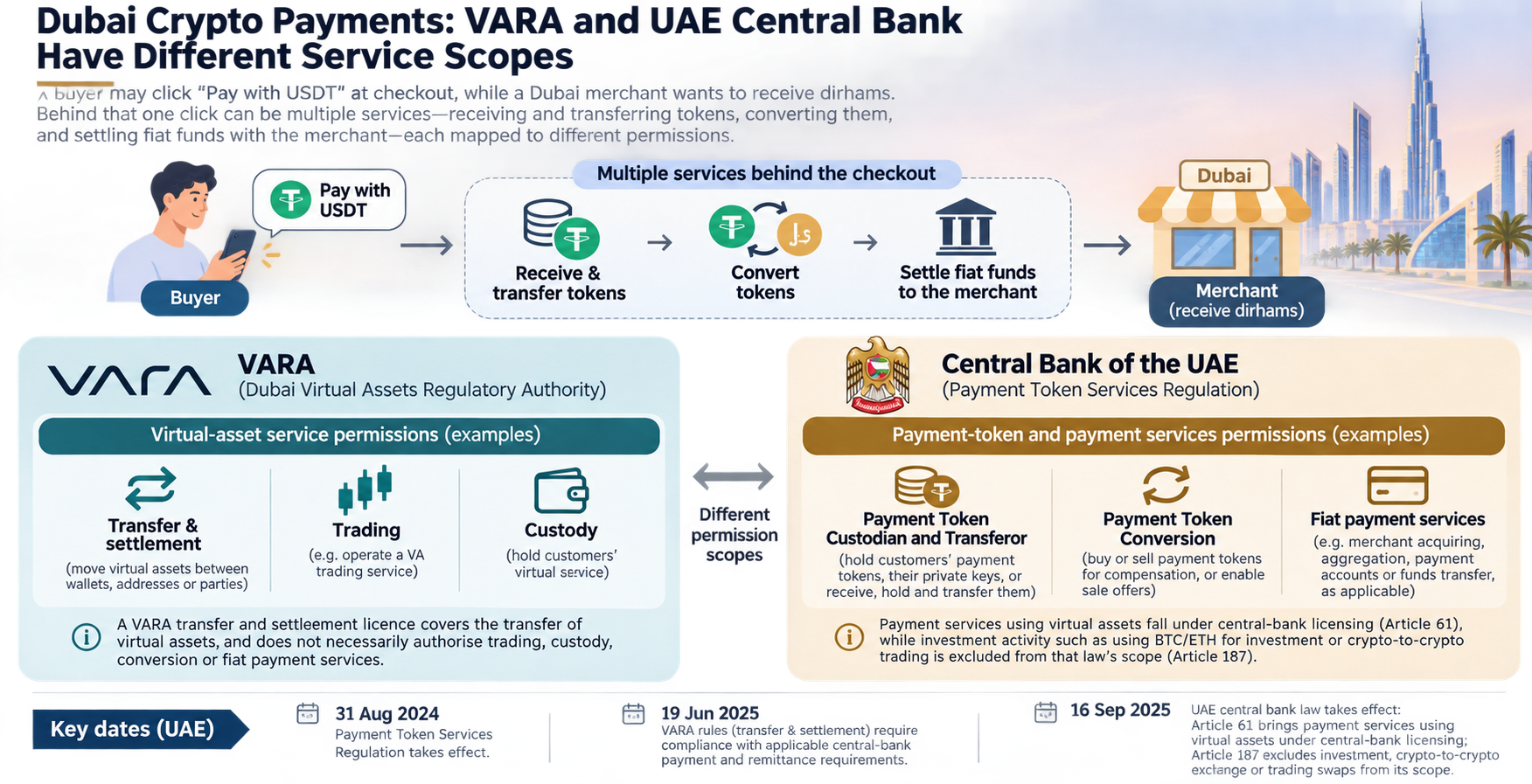
Originally reported on 11 November 2026 at 13:53 (UTC+8). A buyer wants to pay USDT at checkout, while a Dubai merchant wants to receive dirhams. One click for the buyer can involve several different services behind the scenes: receiving and transferring tokens, converting them, and settling fiat funds with the merchant. As the original analysis by Shao Jiadian of Mankun Blockchain Legal Services explains, a Dubai Virtual Assets Regulatory Authority (VARA) transfer and settlement licence does not necessarily authorise a provider to do all three.
Where the VARA licence stops
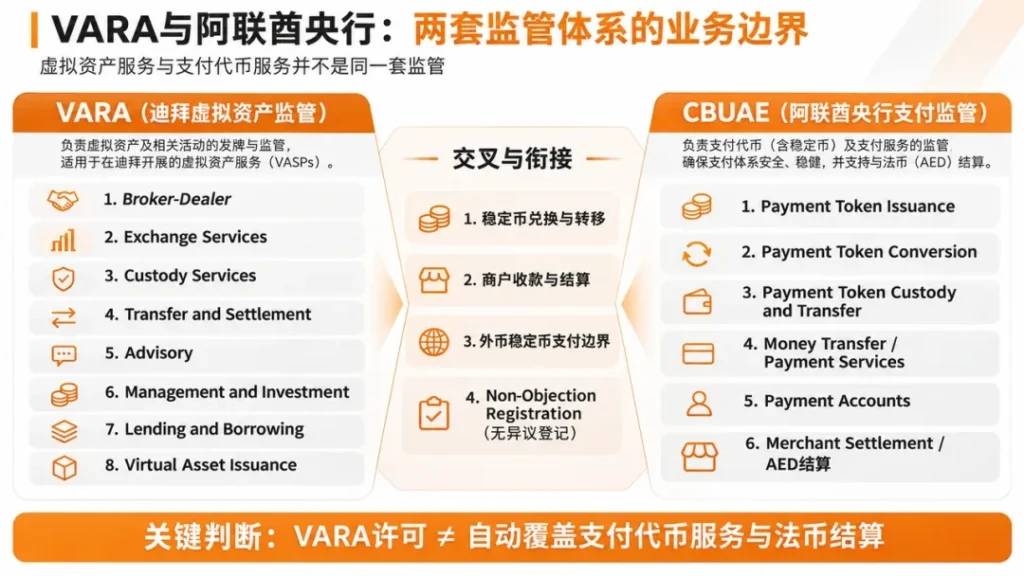
VARA’s transfer and settlement permission concerns moving virtual assets between wallets, addresses or parties. Trading, custody and transfer each have their own VARA permission scopes. For investment activity involving non-payment tokens such as BTC or ETH, with no goods payment, fiat conversion, remittance or other central-bank-regulated service, the activity itself does not require a separate Central Bank of the UAE payment permission, according to the analysis.
The distinction changes at checkout. The UAE central bank law effective 16 September 2025 places payment services using virtual assets within central-bank licensing under Article 61. Article 187 excludes virtual assets used for investment, crypto-to-crypto exchange or trading swaps from that law’s scope, while directing payment and conversion activity to the central bank’s applicable rules. VARA’s rules effective 19 June 2025 also require transfer and settlement licensees to comply with applicable central-bank payment and remittance requirements. Cross-border transfers must be lawful in every jurisdiction involved.
Can the buyer pay USDT if the merchant receives dirhams?
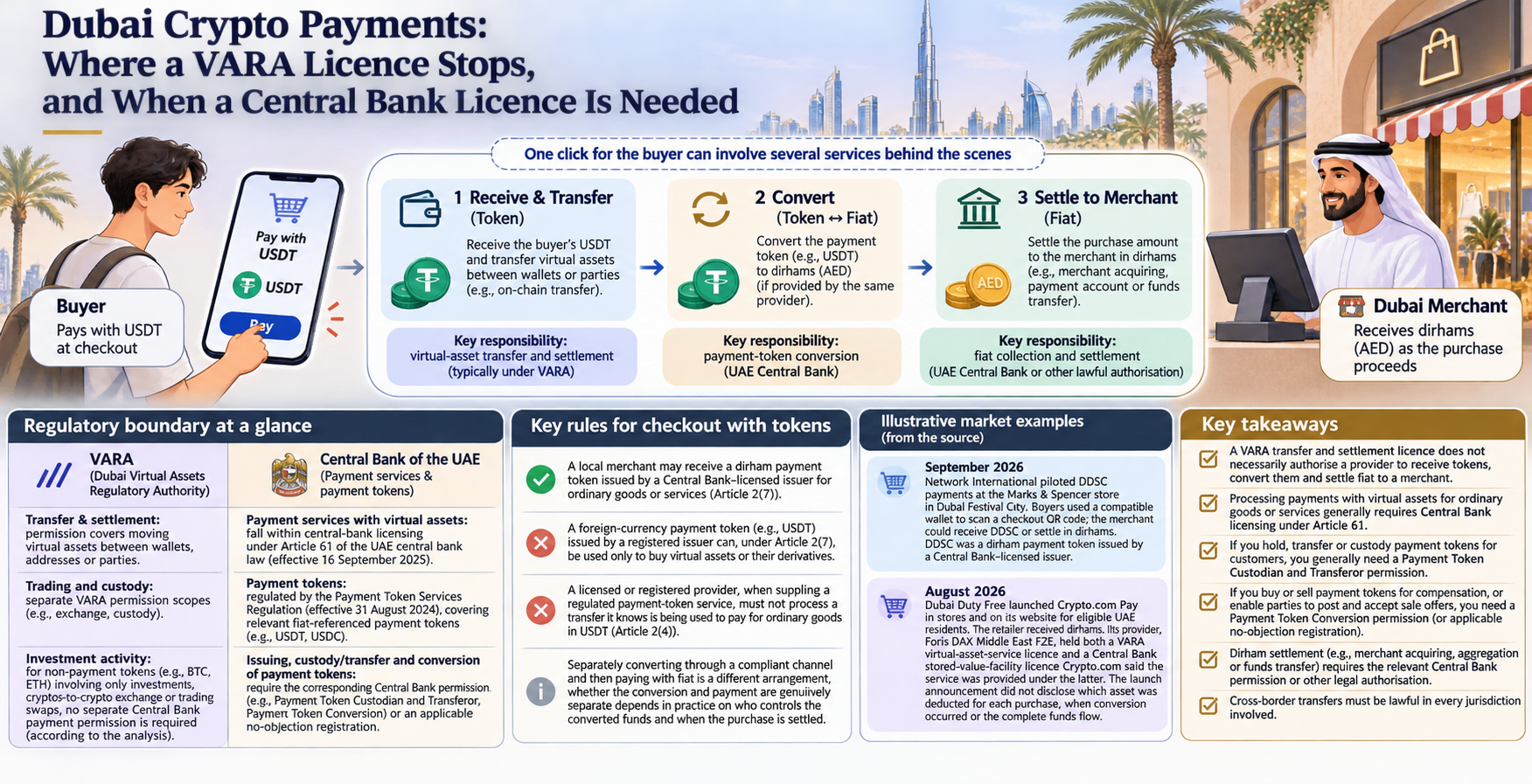
The analysis distinguishes a merchant receiving a token from a provider converting one during checkout. Under Article 2(7) of the central bank’s Payment Token Services Regulation, a local merchant may receive a dirham payment token issued by a central-bank-licensed issuer for ordinary goods or services. A foreign-currency payment token issued by a registered issuer can, under that provision, be used only to buy virtual assets or their derivatives.
Nor does converting USDT before the merchant receives dirhams automatically resolve the issue. Article 2(4) bars a licensed or registered provider, when supplying a regulated payment-token service, from processing a transfer it knows is being used to pay for ordinary goods in USDT, the analysis says. A buyer who separately converts through a compliant channel and then pays with fiat presents a different arrangement; whether conversion and payment are genuinely separate depends in practice on who controls the converted funds and when the purchase is settled.
The source gives two examples without treating them as interchangeable. In September 2026, Network International piloted DDSC payments at the Marks & Spencer store in Dubai Festival City. Buyers used a compatible wallet to scan a checkout QR code; the merchant could receive DDSC or settle in dirhams. DDSC was a dirham payment token issued by a central-bank-licensed issuer. In August 2026, Dubai Duty Free launched Crypto.com Pay in stores and on its website for eligible UAE residents, with the retailer receiving dirhams. Its provider, Foris DAX Middle East FZE, held both a VARA virtual-asset-service licence and a central-bank stored-value-facility licence; Crypto.com said the service was provided under the latter. The launch announcement did not disclose which asset was deducted for each purchase, when conversion occurred or the complete funds flow.
Map permissions to the actual provider
The Payment Token Services Regulation, effective 31 August 2024, covers relevant fiat-referenced payment tokens, including the dollar stablecoins USDT and USDC discussed in the analysis. A business that holds customers’ payment tokens or their private keys, or receives, holds and transfers those tokens for customers, generally needs central-bank Payment Token Custodian and Transferor permission. A business that buys or sells payment tokens for compensation, or enables parties to post and accept sale offers, needs Payment Token Conversion permission or an applicable no-objection registration.
Those registrations have conditions and require central-bank approval. A VARA transfer and settlement licence alone is neither the custody qualification for the Article 8(3) registration route nor the trading-platform qualification for the Article 8(1) conversion route. Existing retail-payment or stored-value permissions may instead bring an activity under their respective rules; permission scopes must still be checked service by service. Applicants for the two central-bank payment-token licences must be companies established in the UAE outside financial free zones, subject also to the regulation’s business-scope restrictions.
Dirham settlement is another question. If the payment provider itself supplies merchant acquiring, aggregation, payment accounts or funds transfer, it needs the relevant central-bank permission or other legal authorisation. A qualified bank or payment firm can instead contract directly with the merchant and provide that service. Calling a bank a partner does not shift responsibility if the original provider signs the merchant, collects and forwards the money, and handles refunds. The practical checks are who contracts with the merchant, controls wallets and accounts, receives payment instructions, and is responsible if funds do not arrive. The same scrutiny applies to any onward transfer to Asia.
A team supplying only an interface or wallet software may fall within an applicable exclusion if it does not itself provide the regulated service. Providing payment initiation or facilitating a regulated financial service through a smart contract still calls for assessment under the relevant rules. Geographic scope matters too: the payment-token regulation addresses services provided within the UAE or to people there, even where a merchant is abroad. Its stated UAE scope and VARA’s jurisdiction exclude financial free zones such as the Dubai International Financial Centre, where the DFSA regime applies.
Source: techflowpost.com (originally published 2026-11-11 13:53 UTC+8)