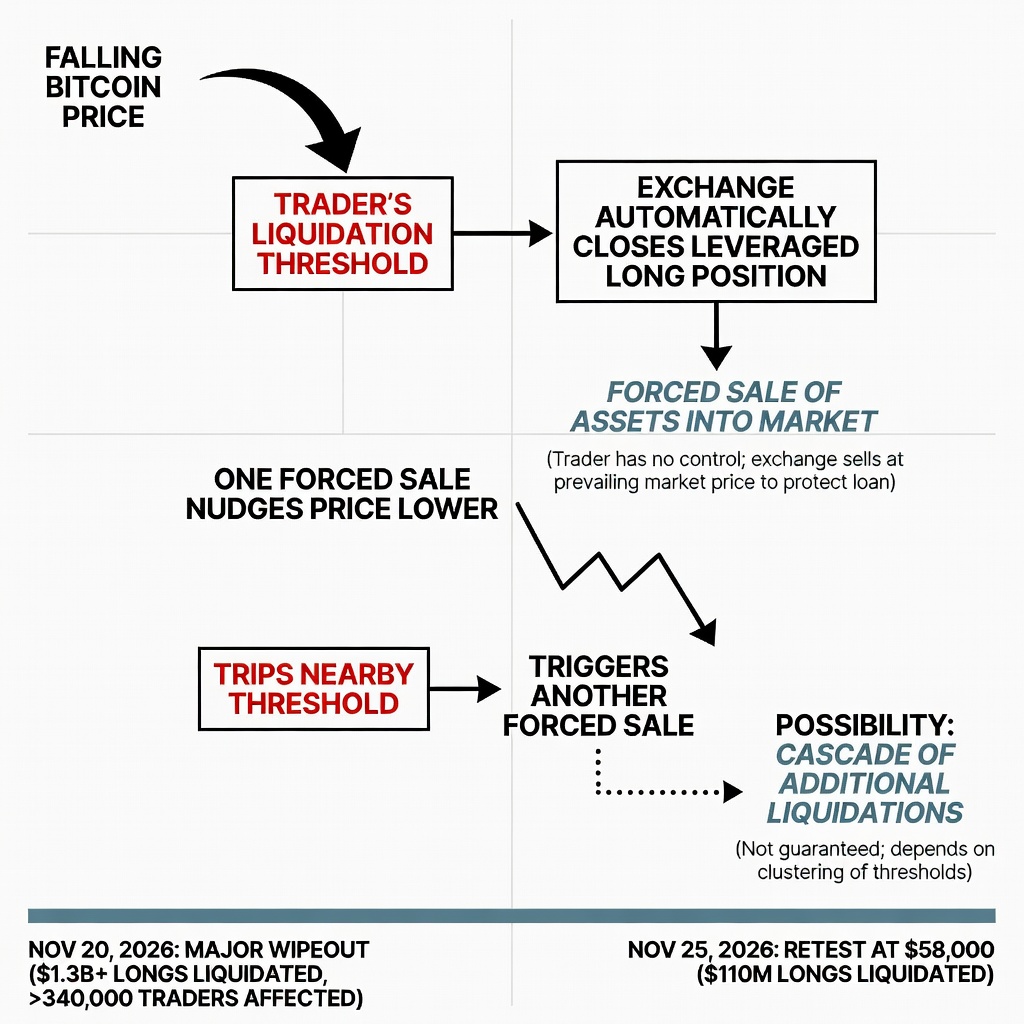
Bitcoin traded between $58,000 and $58,700 on November 25, 2026. As the price fell back to the bottom of that range, exchanges liquidated $110 million worth of leveraged long positions over 24 hours. That was less than a tenth of the roughly $1.3 billion in crypto longs liquidated around November 20.
For a trader using borrowed funds to bet on a price rise, the exit is not always a choice. If the price falls far enough, the exchange automatically closes the position to protect the loan. When many traders have liquidation thresholds near the same price, one forced sale can push the price low enough to trigger another.
The larger swing on November 20
Bitcoin fell to about $55,130 on November 20, its lowest price since September 2024, before rebounding nearly 9% to around $60,300 that same day. Estimates for total liquidations across crypto futures ranged from $1.8 billion to $2.7 billion over 24 hours. Bitcoin futures accounted for more than $1 billion in liquidations, affecting over 340,000 traders.
Data from on-chain analytics firm Glassnode showed that the decline cleared a concentration of leveraged longs between $59,000 and $62,000. Once those positions had closed, they were no longer a source of forced selling. That helped set up a short squeeze on the rebound: traders who had bet on a decline had to buy back their positions as prices rose, adding to demand.
Spot ETF investors also pulled money out
US spot Bitcoin exchange-traded funds recorded estimated net outflows of $1.1 billion to $1.5 billion during the period. Unlike a futures liquidation, a withdrawal from a spot ETF does not require an exchange to close a leveraged trade. The outflows suggest that some investors chose to reduce their Bitcoin exposure while leveraged traders were being forced out.